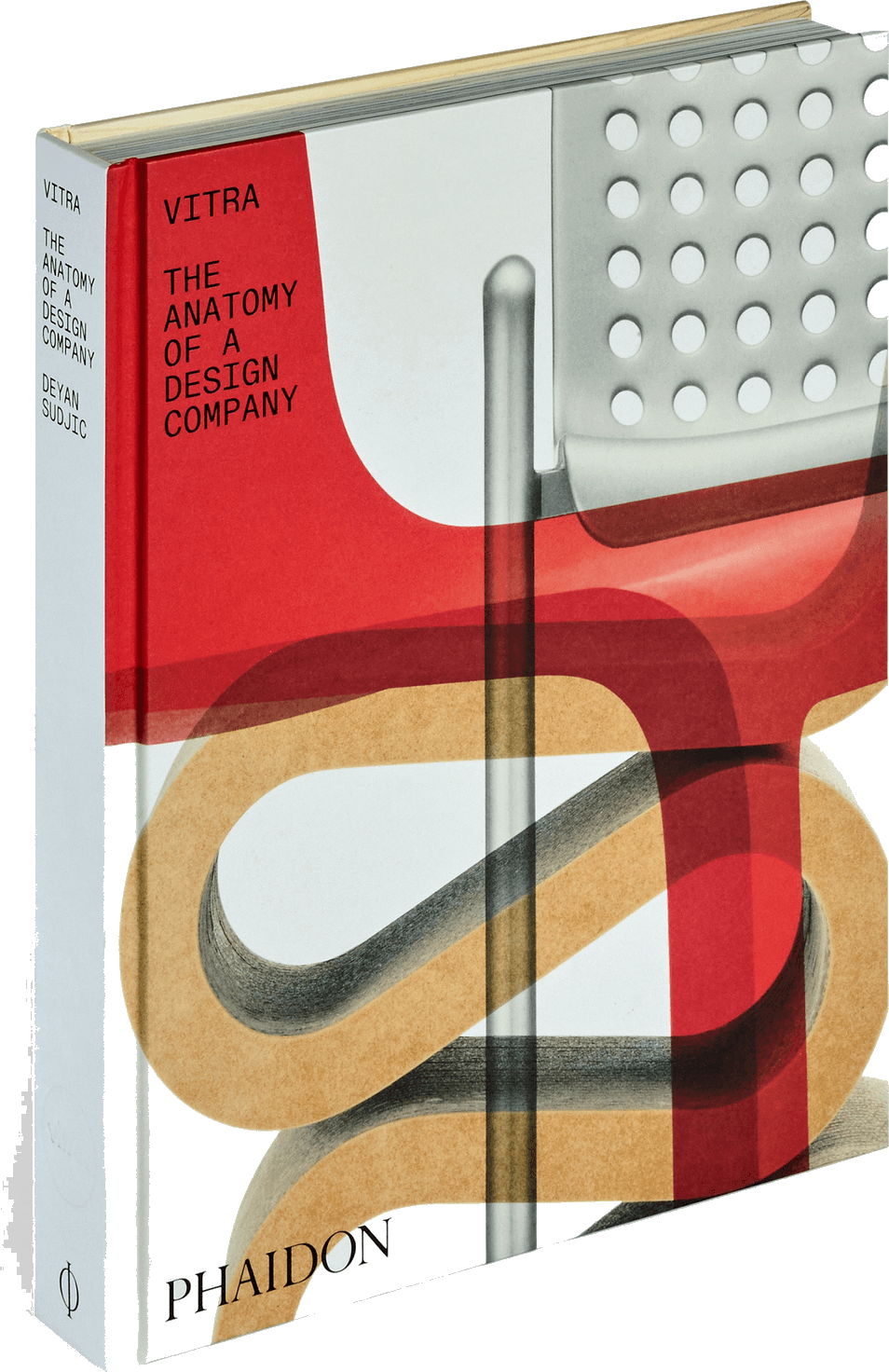
Cover courtesy of Phaidon Press
Design & Type shelf · Hardback
Vitra: The Anatomy of a Design Company
By Deyan Sudjic, Karen Stein, Iwan Baan
270 × 215mm hardback, 410 pages, 400+ illustrations with a photographic essay by Iwan Baan, graphic design by APFEL, and a gatefold insert of the chair collection. At 1.72kg it handles comfortably without overwhelming the table.
- Publisher
- Phaidon Press (2025)
- Imprint
- Phaidon
- Pages
- 410 pages
- Size
- 27 × 22 cm
- Weight
- 1.7 kg
- Binding
- Hardback
- ISBN-13
- 9781837290000
An authoritative account of the company that turned a Swiss shopfitter's encounter with an Eames chair in 1950 into one of the world's more consequential design operations — dense with archival material and well worth the shelf space.
The editors' view
Written by Eliza Marchant
In 1950, Willi Fehlbaum, a Swiss shopfitter, saw a chair in New York made by Charles and Ray Eames and decided he wanted to make it. That encounter — accidental, intuitive, commercially improbable — is where the Vitra story begins. Seventy-five years later, the company that grew from it runs a campus in Weil am Rhein where buildings by Tadao Ando, Herzog & de Meuron, Frank Gehry, Alvaro Siza, and Zaha Hadid stand in a field next to the Rhine. The trajectory from shopfitter to architectural destination is the subject of this substantial Phaidon monograph.
Deyan Sudjic, former director of the London Design Museum and one of the more reliable critics working in design publishing, had access to the company archives and to Rolf Fehlbaum, who ran Vitra for more than three decades following his parents. The book is built on oral histories and archival research and is structured to show not just the famous names but the less obvious ones: Jean Prouvé, whose furniture Vitra salvaged and distributed; Alexander Girard, whose textile archive they preserved; Luis Barragán, whose work they championed. The argument — that Vitra's influence extends far beyond the furniture it sells — is made through accumulation of evidence rather than polemic.
Six illustrated essays by Karen Stein, an architectural adviser and writer, run through the book as a kind of sidebar, each examining a different facet of the operation. The photographic essay is by Iwan Baan, the architectural photographer known for placing buildings in the context of use. Graphic design by APFEL, the London practice. The production includes a gatefold showing 24 chairs from the collection in sequence — a useful reminder that for all the cultural apparatus, this is still a furniture company.
At 270 × 215mm and 410 pages, the book is substantial without being overbearing. Anyone who owns the chairs is likely to find it useful; anyone interested in how a design company accumulates cultural authority over three generations will find it thorough.
Shelved alongside

Chosen by Eliza
Tadao Ando: Light and Space
Tadao Ando, Richard Pare, Dominique Perrault
280 pages29 × 25 cm